

Restoring Coherence
The work that doesn't compound

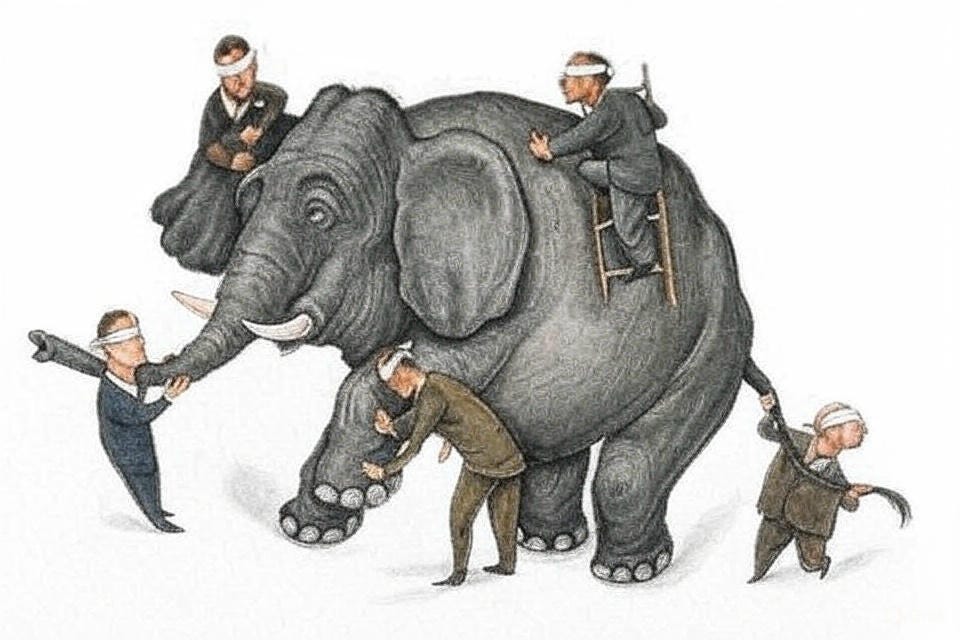
Everybody’s describing the same animal.
I didn’t start building Control+S because I woke up one morning and felt inspired by compliance. I started because I kept watching the same kind of good teams lose time in the same kind of stupid way. Teams with real security leadership, real operational discipline and a genuine desire to be honest about their posture. The kind of teams you want inside a serious environment. And still, quarter after quarter, they’d end up dragged into the same cycle: the evidence existed, the controls were stronger than the last time, the systems were cleaner than the last time and yet the work still felt like starting over. The explanation everybody uses, more frameworks, scope and scrutiny wasn’t wrong, but it didn’t capture the weight of what was happening.
The exhaustion wasn’t only that there was more to do, it was that the effort didn’t accumulate. It dissolved.
For years the category improved the parts that are easy to productize and easy to sell. Evidence has somewhere to live. Workflows aren’t email threads anymore. Ticketing systems connect into something that looks like a program instead of a scramble. GRC platforms earned their place by making the mess legible. That layer mattered. But the first layer the category industrialized was logistics, not interpretation and interpretation is where the load lives now. Once you accept that, a lot of the “why is this still so hard” hand wringing stops being mysterious. Compliance didn’t just get bigger. It got linguistically crowded. Frameworks describe the same underlying reality through different structures and assumptions: what counts as proof, how time is defined, whether maturity is implied or explicit, whether policy cadence is sufficient or technical evidence is required. Each framework can be coherent on its own, but they weren’t built to interoperate and they weren’t written with the human cost of reconciliation in mind. That’s the shift nobody accounts for when they talk about “evidence collection” like it’s the hard part.
The hard part is what the artifact means here, under this lens, in this scope, across this window of time with reasoning strong enough to survive scrutiny when someone else reads the same material through a different frame.
That’s the moment the work stops being administrative and becomes interpretive. A company still has one lived reality: systems, people, controls, permissions, policies, tickets, procedures, logs, reviews, failures, corrections, actual behavior under pressure. Frameworks describe it and they carve it differently. The organization isn’t just satisfying requirements anymore. It’s translating itself over and over across overlapping but incompatible descriptions of what “responsible operation” looks like. And because those descriptions don’t align naturally, teams keep paying a tax in the only place they can, the explanation. That’s where effort goes to die.
You can watch this happen in real time because the objects are ordinary. A screenshot is never just a screenshot for very long. A policy is never just a policy. A ticket is never just a ticket. Each artifact arrives looking simple, then starts splitting into implications the moment it encounters multiple frameworks and multiple reviewers. The quarterly access review export is the cleanest example because it’s the kind of thing everyone has. Under one standard it reads like solid evidence that access is being reviewed on cadence. Under another lens it reads as incomplete because the question moved. Now the control isn’t asking for a point-in-time view of one system, it’s asking how permissions are managed across the environment. Nothing operational changed. The burden moved into the explanation.
From far away this looks like paperwork. It isn’t paperwork. It’s repeated interpretive reconstruction.
Smart people doing expensive work that produces no durable memory for the system that consumed it. Professionals who understand their environment deeply, forced back to the blank page every time the scope shifts, the reviewer rotates, or a new framework enters the room with its own assumptions about how proof should behave. And then you see the real design failure. We keep the attachment and lose the reasoning.
That blank page is more damaging than most people realize because it’s not only inefficient, it is an insult to expertise.
Mature disciplines don’t ask professionals to repeatedly recreate the preconditions of their own judgment if those preconditions can be preserved, audited, improved and reused. Your accountant doesn’t reinvent the concept of materiality every quarter. Your lawyers don’t rewrite precedent as if it never existed. Medicine advanced by formalizing evidence, comparability, protocol and judgment in ways that could travel. Compliance, as it’s practiced in most modern tooling, keeps artifacts and discards the part that makes the artifacts sufficient. The evidence gets archived. The workflow gets tracked. The approval trail exists. But the rationale, why this was enough under this framework, what assumptions were made, what gaps were acknowledged, what would change the conclusion, rarely survives the cycle in a form the system can reuse. So when the lens changes, the work doesn’t evolve. It resets.
Once I accepted that this was the real bottleneck, the obvious question became unavoidable: why hasn’t the category addressed it? And the answer isn’t flattering, but it’s understandable. The market rewarded the visible layer first. Logistics are tangible. A dashboard demos well. A workflow diagram sells. “Look, we can ingest from 40 systems” is easy to understand and easy to buy. Interpretation is not. Interpretation forces you to admit uncertainty, to hold contradictions long enough to resolve them, to keep a record of what you assumed, and to expose gaps instead of burying them under a confident narrative. And it’s difficult to productize because the category has treated control language as inert text and evidence as inert files. If those are your primitives, you end up with a system that routes things beautifully and forgets what they mean.
That is the moment the project stopped being “compliance tooling” in my head and became what it actually is: a memory problem. The expensive part of the work has shape, and yet the system behaves as if it doesn’t. Controls aren’t arbitrary paragraphs. They encode actors, conditions, sequences, expectations, boundaries and time assumptions. Evidence artifacts aren’t just files, they contain structured signals about ownership, recency, environment, implementation state, governance linkage and operating reality. A ticket chain implies sequence and execution. A screenshot suggests system state at a particular moment in a particular environment. A policy implies intent, authority, cadence and the relationship between governance and enforcement. A log export reveals activity, timing, actors and sometimes absence.
The tragedy is that humans do the hardest synthesis across those signals and then most systems throw the synthesis away. They keep the source material, the timestamps, the workflow, the approval trail. They lose the interpretive architecture that made the whole thing useful. Then everyone acts surprised when the next cycle feels like starting over. It feels like starting over because it is.
So we reframed the asset, the mapping. The relationship between requirement and proof and the rationale that makes that relationship defensible.
The decision, preserved as something that can be reviewed, revised and improved rather than rewritten from scratch. Once you treat the mapping as the asset, you stop thinking in terms of “storage” and start thinking in terms of “structure.” You stop asking how to make collection smoother and start asking how to make reasoning durable. You also stop trying to build a system that replaces expertise and start building a system that stops wasting it.
That’s what Control+S is. It exists because we got tired of watching the mapping layer consume expert time and then disappear as if that time had never produced anything durable. It exists because modern compliance still asks highly trained people to do the same expensive interpretive work in slightly different shapes across slightly different frameworks while the underlying logic never becomes part of the operating memory of the system. It’s not a prettier place to put evidence. It’s a reasoning layer designed around one conviction, the first pass of compliance reasoning should not have to begin from nothing every time. If that sounds obvious, good. “Obvious” is usually what we call a truth we’ve been living around for years because it’s inconvenient to acknowledge.
The design work lives in the primitives. We treat control language as structured requirements rather than inert text. We treat evidence as operational records with context rather than loose attachments. We treat mapping itself as a first class object that can be inspected, challenged and improved, including explicit gaps because gaps are often the only honest part of a compliance story. And we preserve rationale as versioned memory, a living record of why something was considered sufficient, what assumptions were in play, what changed and what remains unresolved. The point is not to remove human accountability. The point is to stop forcing humans to waste themselves on repeated first pass reconstruction. Experts still review. Challenge. Decide. Own the outcome. But their energy gets reserved for the places where expertise earns its keep instead of being consumed by rebuilding the same semantic bridges every time the system forgets what it learned last quarter.
We deployed Control+S inside a large national security organization in Canada operating under federal contracts. The roughly 80% reduction in interpretive workload is an internal measurement, not a public benchmark. I’m careful about even stating it because I’ve watched this space get drunk on numbers that don’t travel.
But directionally it’s the only point that matters: when the mapping layer is formalized and the rationale persists, the work stops resetting. That’s the real victory.
The team stops rewriting arguments and starts improving them. Experts stay where they belong, correcting edge cases, exercising discernment, defending conclusions because they arrive to a body of logic rather than a void. The blank page begins to disappear.
The part I care about most is what that does to trust. Semantic fragmentation leaks into procurement because procurement is a risk filter and risk filters punish incoherence. It leaks into enterprise sales because trust is now part of how serious buyers evaluate maturity before a contract is signed. It leaks into diligence because sophisticated counterparties are not looking for documentation so much as contradictions. A company can do the work and still fail to explain itself. That is the failure mode in compliance. The controls may exist. The evidence may exist. The teams may be competent. But under scrutiny, the organization is forced to describe itself through multiple vocabularies that were never designed to reconcile. Security speaks one way. Compliance another. Legal another. Product and engineering another. Each framework adds its own grammar.
So the real question is whether the organization can explain itself in a way that holds together.
That is where the category is going whether we like it or not. Compliance is no longer an annual event. It is an always on proxy for whether a company can be trusted inside serious environments. The “evidence layer” matters, but it’s no longer decisive. The decisive layer is whether the system can preserve the expensive part of the work, the relationship between requirement and proof, the rationale that makes sufficiency defensible, and the coherence that has to hold across frameworks, cycles and people.
If you’ve read my work for a while, you know I’m not sentimental about tools. Tools are not morals. Incentives are. Categories mature when they stop optimizing around their most visible mechanics and begin addressing the thing those mechanics were never sufficient to solve. In this case, that thing is reasoning. And yes, that makes some people uncomfortable, because reasoning exposes what everyone would rather keep implicit: assumptions, gaps, edge cases and the difference between “we have an artifact” and “we have a defensible claim.”
This is not a call for less rigor. It’s a call for less amnesia. It’s an insistence that the work people keep rebuilding by hand has shape and because it has shape, it can be formalized without removing human accountability. Once you admit that, the category stops being a pile of folders and starts becoming what it always should have been: a discipline that gets sharper every cycle instead of restarting every cycle.
The whitepaper is the formal articulation of the engine: the primitives, the mapping layer, the audit trail and the accountability model that keeps humans in charge while the reasoning actually persists. This post is the readable argument for why that layer matters. If you live in this work, treat it like a stress test, tell me where it breaks. The goal isn’t prettier compliance. It’s stopping the same expert work from being rebuilt by hand every cycle.